|
Daily Dose of Reason -
Psychology & Self-Improvement
|
|
Written by Michael J. Hurd, Ph.D.
|
|
Wednesday, 10 March 2010 00:00 |
|
Q: I don't think I understand your conclusion regarding "Career Like Marriage" [see Daily Dose of Reason for March 6, 2010]. Are you saying that by accepting less than one's ideal romantic or career choices, one precludes the possibility of ever doing so? Surely, a lifelong commitment to personal growth, would create the possibility of finding and enjoying one's most desired passions, even late in life. It would seem that the quest, itself, would bring purpose and happiness to the journey. Unfortunately, ideal romantic love involves the choices of two souls, whereas, finding a career passion can usually be achieved by one. If less than complete happiness is achieved in one's life, isn't that better than none at all; or, have I totally missed your point?
A: No, you’re contributing to my point. There’s a distinction between a career commitment and merely a job. A career is a form of work you “marry,” while a job is something you can do with productivity and pride, but you’re not in any sense married to it. I’m saying: don’t make a career commitment unless you find work worthy of your highest productive efforts and focus. In a totally free and rational society, almost everyone would be able to do this. In less than rational societies, some can and some honestly cannot find a career to love. Our society, while still the best one to live in on earth, is encumbered by stupid ideas (many documented at this web site) that lead to stupid policies, including political ones, that make for fewer fulfilling lines of work than would otherwise exist. I am suggesting, like you, that some happiness is better than none at all. If you cannot find a career worthy of committing to like you would to a marriage, you can still be productive—and pursue other values in life, instead … OR until you find that career love which, I agree, could even happen later in life. You’re correct that love requires two individuals while a career only requires one. The possibility of finding career happiness is greater than the possibility of finding romantic love in the highest form you might like. Neither is impossible—and both are important enough to refuse to give up on, no matter what the times or culture are like. In romance and career, aim for the stars—and go as far as you can go. |
|
|
Daily Dose of Reason -
Quotations
|
|
Written by Michael J. Hurd, Ph.D.
|
|
Tuesday, 09 March 2010 00:00 |
Economist Ludwig von Mises, in an unpublished letter to Ayn Rand complimenting her on her classic novel "Atlas Shrugged:"
"You have the courage to tell the masses what no politician told them: you [the masses] are inferior and all the improvements in your conditions which you simply take for granted you owe to the effort of men who are better than you."
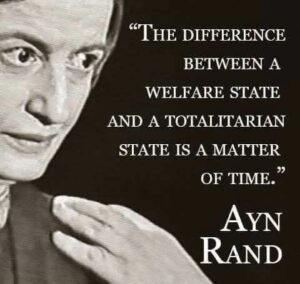
Ayn Rand was universally mocked and despised by the critics of her own age, and ours. Yet her most famous book continues to be a huge best-seller, second in influence (according to one poll) only to the Bible.
Who says the truth won't sell? |
|
Daily Dose of Reason -
Quotations
|
|
Written by Michael J. Hurd, Ph.D.
|
|
Monday, 08 March 2010 00:00 |
|
“Everyone wants to live at the expense of the state. They forget that the state wants to live at the expense of everyone.”
-- Frederic Bastiat |
|
Daily Dose of Reason -
Politics & Government
|
|
Written by Michael J. Hurd, Ph.D.
|
|
Sunday, 07 March 2010 00:00 |
|
Liberty and democracy are not the same thing. Liberty refers to the individual's right to be free from force. Democracy is merely the right to vote -- and it's secondary to liberty. If democracy were elevated to liberty, then this would mean one group of people have the right to vote away the rights of another group. In fact, that's what America has become. Fifty-one percent of the population, who wants health insurance without having to pay or work for it, has the right to require the other forty-nine percent of the population to pay for it. It's also socialism. Socialism and democracy, when elevated above liberty, means coercion. It's the coercion of some for the sake of others. Sometimes it involves the coercion of the majority against some minority. This happens with the income tax, where the wealthiest and most productive in society pay the bulk of government's bills for the sake of the middle and lower classes, who outnumber them. The income tax is not just; it's simply brute force based on sheer numbers. People think of the United States as the land of liberty, and while some liberty still exists in the United States (freedom of speech, freedom to worship or not worship, freedom to mate with whom you choose), most economic and business matters are no longer based on liberty.
Today's politicians are attempting to reduce the role of liberty in every aspect of our lives, to the point of a European socialist state or even worse. If you want to fight for liberty, don't fight merely to preserve it -- but to restore it. Liberty is not a matter of majority vote. It's what you're entitled to, what we're all entitled too -- and is the only thing we're entitled to. |
|
|
<< Start < Prev 1 2 3 4 5 6 7 8 9 10 Next > End >>
|
|
Page 1 of 186 |